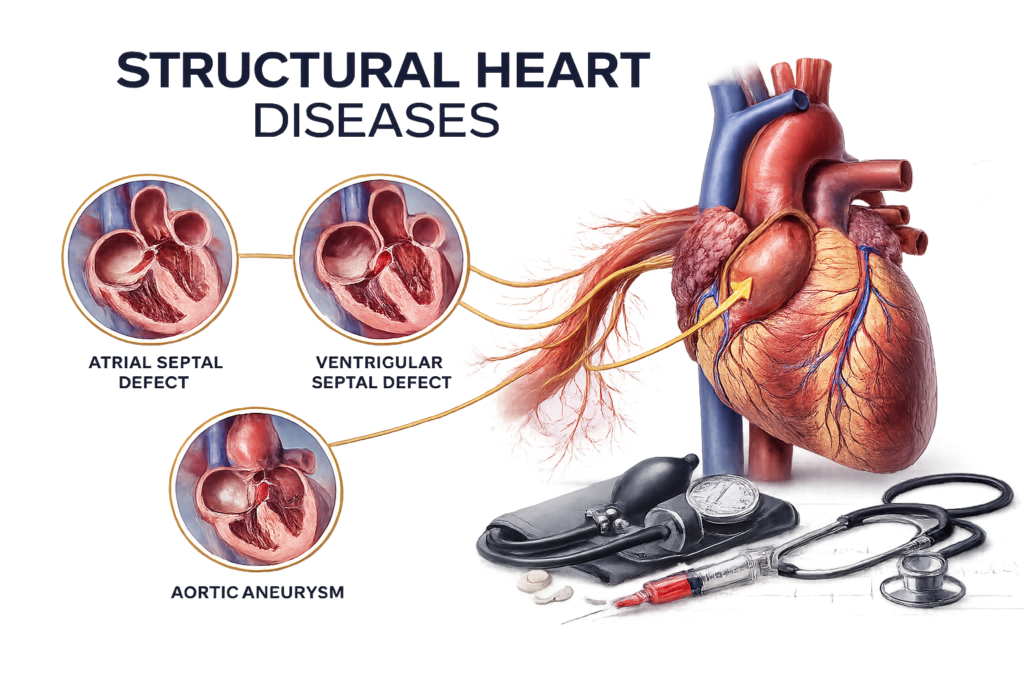
On the other hand, structural heart diseases refer to a group of health conditions that impact the physical structure of a person’s heart, including their chambers, heart valves, heart walls, and major blood vessels. This category of health conditions can occur at birth, as well as develop as a result of ageing, infections, and other health complications.
Unlike coronary heart disease, which involves blood flow through a person’s coronary arteries, structural heart diseases involve a person’s heart formation as well as how it functions mechanically.
Some structural heart diseases tend to remain constant in a person’s life, while others may worsen over time.
There are various heart diseases that fall under the category of structural heart disease, which may need special care.
Hypertrophic Obstructive Cardiomyopathy (HOCM)
This is a condition where there is abnormal thickening of the heart muscle, especially in the left side of the heart.
Left Atrial Myxoma
This is a non-cancerous tumour that occurs inside the heart, especially on the left side. This tumour may interfere with the flow of blood, thus its timely treatment is required.
Ascending Aortic Aneurysm
This is characterised by the enlargement or bulging of the aorta, which is the main artery that carries blood out of the heart. If not treated, serious consequences may result, such as rupture or tearing of the aorta.
Constrictive Pericarditis (Pericardiectomy Cases)
This is a condition where there is abnormal thickening of the pericardium, which is the outer layer of the heart. In serious cases, removal of this layer is required, a process known as pericardiectomy.
Structural heart diseases may result from the following:
It is important to note that once the cause of a heart disease is known, it is easier to manage it appropriately.
The symptoms depend on the type and severity of the problem. Some patients may not show symptoms during the early stages of the problem.
The common symptoms include:
If the symptoms are severe or of sudden onset, immediate medical attention is required.
Accurate diagnosis is essential to determine the type and severity of structural heart disease.
Common tests include:
Echocardiography (2D Echo) – primary diagnostic tool
Cardiac MRI / CT Scan – detailed structural imaging
Electrocardiogram (ECG) – heart rhythm evaluation
Cardiac catheterisation
– used in complex cases
These tests help specialists plan the most appropriate treatment approach.
The treatment varies depending on the condition, severity, and state of the patient.
Medical Management
Medications may be prescribed to manage the condition and improve heart function.
Minimally Invasive Procedures
In some cases, abnormal heart structures may be corrected through catheter-based procedures, thus reducing the time of recovery.
Surgical Treatment
In severe cases, surgery may be performed to correct abnormal heart structures, remove tumours, and repair damaged heart areas.
Structural heart diseases often involve complex diagnoses and major treatment decisions, including surgery.
Seeking a cardiac opinion helps:
Confirm whether surgery is necessary
Evaluate alternative or less invasive options
Understand the risks and timing of procedures
Avoid unnecessary interventions
An expert cardiac review provides clarity before making critical decisions.
Upload your medical reports and receive an independent review from experienced cardiac specialists before making any major treatment decision.